

What if a community could remember its history not only through books and monuments, but through the names given to generations of its own people?
For generations, the Agĩkũyũ developed a social institution known as the riika, plural mariika, commonly translated as an age-set or initiation group. It was far more than a way of grouping people according to age. The system helped organize social responsibilities, initiation, education, community defence, leadership and relationships across family and clan lines.
The riika also became an important way of preserving memories of events that shaped Kikuyu society. Diseases, famine, new technologies, political developments and cultural changes could become associated with particular generations. In this way, the history of a community could remain connected to the people who experienced it.
What Exactly Was a Riika?
The word riika could carry more than one meaning. In its narrower sense, it referred to an initiation set, a cohort of young people who underwent traditional initiation around the same period. In a broader sense, it could refer to a generation with wider social and political significance.
This distinction matters because the system was not simply a method of classifying people by birth year. A person belonged to a family and clan, but could also belong to a particular generation or initiation cohort. These different identities created overlapping networks of belonging, cooperation and responsibility.
The Riika Crossed Family and Clan Lines
A young person entering a riika could form lasting relationships with people from families and clans other than their own. The system therefore created a generational network that extended beyond ordinary kinship relationships.
Family provided ancestry, while clan provided another important level of identity. The riika added a generational connection that could influence social relationships and responsibilities throughout adulthood. This helped create a wider sense of community among people who might otherwise have been separated by family or clan boundaries.
Initiation Was a Passage Into Adulthood
Traditional initiation, commonly referred to as irua, marked an important transition from childhood toward adulthood. It was not simply a physical rite, but also a process through which young people were introduced to the expectations and responsibilities of adult life.
They learned about social conduct, community values, traditions and responsibilities. The underlying principle was significant: becoming an adult meant becoming more useful and accountable to society. The transition therefore connected personal development with the wellbeing of the wider community.
Your Generation Had a Name
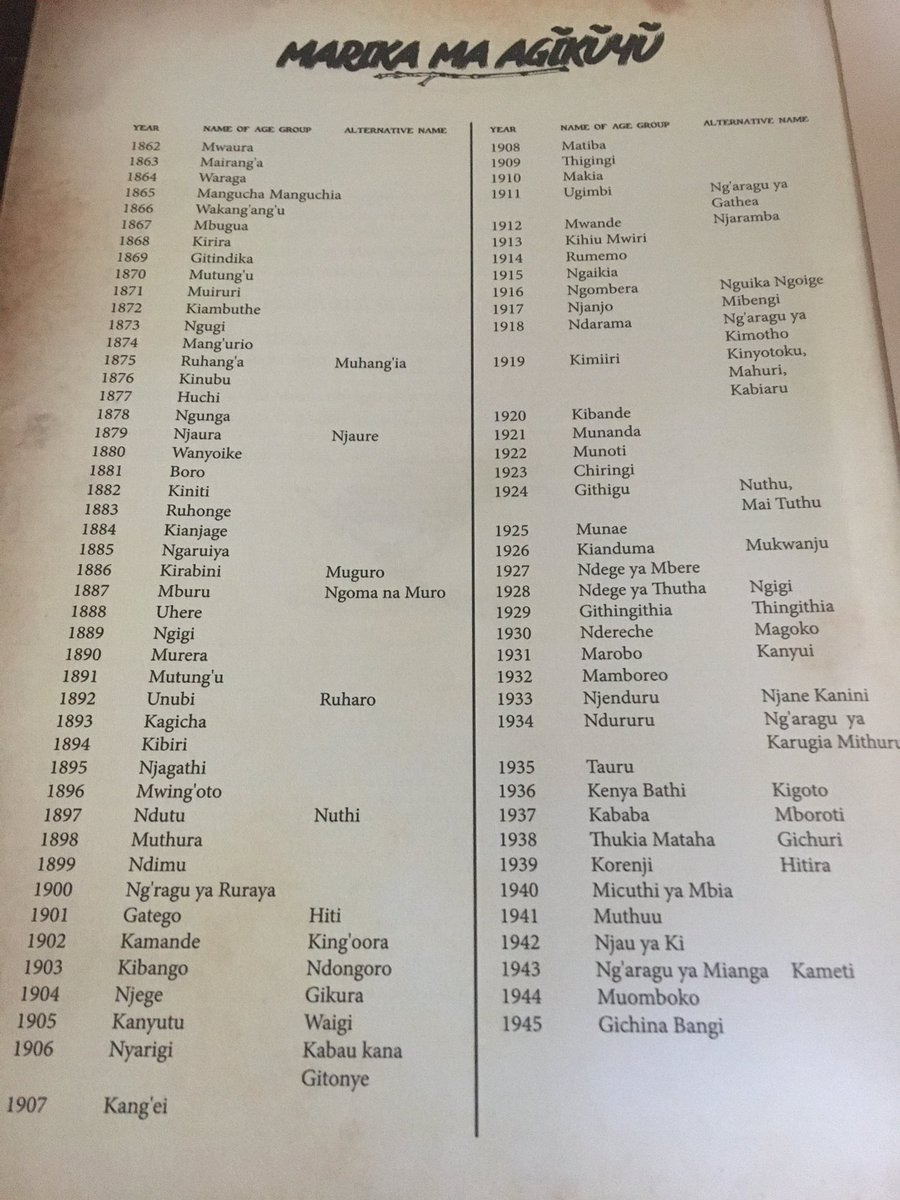
One of the most intriguing features of the system was the naming of generations. Historical accounts indicate that initiation sets could receive names associated with significant events occurring around the period of their initiation.
A 2020 KenyanList discussion provides numerous examples drawn from Kikuyu community history. Because the discussion is a community source rather than an academic publication, individual dates and interpretations should be treated as oral-history traditions rather than definitive historical chronology.
Nevertheless, the principle it illustrates is remarkable. A generation could carry the memory of the period in which it came of age. The name could therefore become a reference point through which older members explained the circumstances surrounding their generation.
When Disease Became a Generational Marker
The KenyanList account associates Rika ria Mutung’u with the smallpox outbreak remembered around 1870 and identifies other generations with periods of disease and hardship. These accounts provide an interesting window into how major events could become attached to the identity of a generation.
The same principle applied to famine and other periods of hardship. A generation that experienced severe difficulties could become associated with those circumstances, allowing later generations to connect particular groups of people with important moments in community history.
When New Technology Entered the Story
The naming tradition did not stop with natural disasters. As colonial rule expanded and new technologies and institutions entered Kikuyu society, they could also become part of generational memory.
The KenyanList account associates names such as Kibande with an identity document around 1920, Munanda with cattle dipping around 1921 and Chiringi with the shilling around 1923. These examples are particularly revealing because they show how the naming tradition could respond to changes taking place in everyday life.
The riika was therefore not simply preserving an ancient world. Its vocabulary could reflect the changing environment around the people who belonged to it.
When an Aeroplane Became History
Then came the aeroplane. The KenyanList account records Ndege ya Mbere, associated with an early aircraft sighting around 1927, followed by Ndege ya Thutha in 1928.
For communities encountering powered flight during its early years, an aircraft appearing in the sky could have been an extraordinary experience. The tradition provides a striking example of how an unfamiliar technology could become part of local cultural memory and eventually be associated with an entire generation.
Even Disasters Could Be Remembered
The same KenyanList discussion associates Githingithia with a major earthquake remembered around 1929. While individual attributions from oral traditions require careful historical verification, the example illustrates the wider role of generational names as informal chronological markers.
Instead of remembering every important event through a written year, people could connect an event to the generation that experienced it. This gave oral memory another way of organizing the past and passing it from elders to younger generations.
The Riika Was More Than a Historical Calendar
It would be a mistake to reduce the riika to an interesting list of generation names. Generation sets had social, political and administrative importance within traditional Kikuyu society.
They helped organize people and responsibilities while creating relationships between generations. The system was therefore simultaneously concerned with identity, responsibility, social order and succession.
This becomes especially clear when examining Ituika, one of the institutions associated with the transfer of authority between generations.
Ituika: When Authority Changed Generations
Ituika was associated with the transfer of authority from one generation to its successor. Historical research places these transitions at approximately 30 to 40-year intervals, although chronology differs among sources.
The process was connected to political, judicial and religious responsibilities. Its importance lay in the principle that authority was not supposed to remain permanently with one generation.
One generation exercised responsibility while another matured and prepared to take its place. Leadership therefore had a cycle, creating an expectation that authority would eventually be transferred.
Maina and Mwangi
Two names appear repeatedly in discussions of the broader Kikuyu generation system: Maina and Mwangi. Historical accounts describe these as major generation identities associated with the political organization of Kikuyu society.
Their relationship to generational succession is often discussed alongside Ituika. However, historical chronology is not completely uniform across all sources, and different scholars and oral traditions provide varying accounts of earlier generations.
This is an important reminder when studying African oral history. Differences between traditions do not automatically mean that the underlying social system was insignificant or poorly organized.
Riika and Mbari Were Different
The mbari was primarily connected to family and lineage, while the riika created a generational relationship. The two were not competing systems but different structures through which people understood their place in society.
One connected people through ancestry. The other connected them through generation and shared social experience. Together, these structures created a layered system of identity that helped organize relationships within traditional Kikuyu society.
A Living Archive
Perhaps the most remarkable feature of the riika was its role in preserving collective memory. A generation received a name, the name survived, elders explained its meaning and younger people learned the story behind it.
In this way, historical knowledge could move from one generation to another without depending entirely on written records. Oral traditions are not automatically precise, and memories can change across regions and generations, but they remain important sources for understanding how communities remembered their past.
The riika demonstrates that a society does not need a modern archive to preserve historical consciousness. People themselves can become carriers of history.
How Colonialism Changed the System
The traditional Kikuyu age-set system was transformed by colonial rule, Christianity, formal education, wage employment, urbanization and the growth of modern state institutions.
Some elements survived in modified forms, while others declined or disappeared. Traditional initiation practices also require historical context because some practices associated with initiation are prohibited or harmful today.
Studying the riika therefore does not mean reproducing every practice from the past. It means understanding the social structures, values and historical memories that shaped Kikuyu society.
What the Riika Can Teach Modern Kenya
The riika raises questions that remain relevant beyond Kikuyu history. How does a generation define itself? How should knowledge move from older people to younger people? When should responsibility change hands?
The traditional system connected age with responsibility and leadership with succession. This makes the riika relevant not only as a subject of Kikuyu cultural history, but also as a window into broader African approaches to community organization.
The Generation That Remembered Its World
From disease and famine to aircraft, money, technology and changing cultural influences, the stories attached to Kikuyu generations reveal a society constantly responding to change.
The riika gave those generations an identity and helped organize their responsibilities. Through names and oral traditions, it also preserved memories of the world they encountered.
That is why the Kikuyu age-set system deserves to be understood as more than an initiation tradition. It was a social institution, a framework for generational identity, a component of traditional governance and an important vehicle for transmitting collective memory.
The history was not always written in books. Sometimes, it was carried by the people who lived it.
