

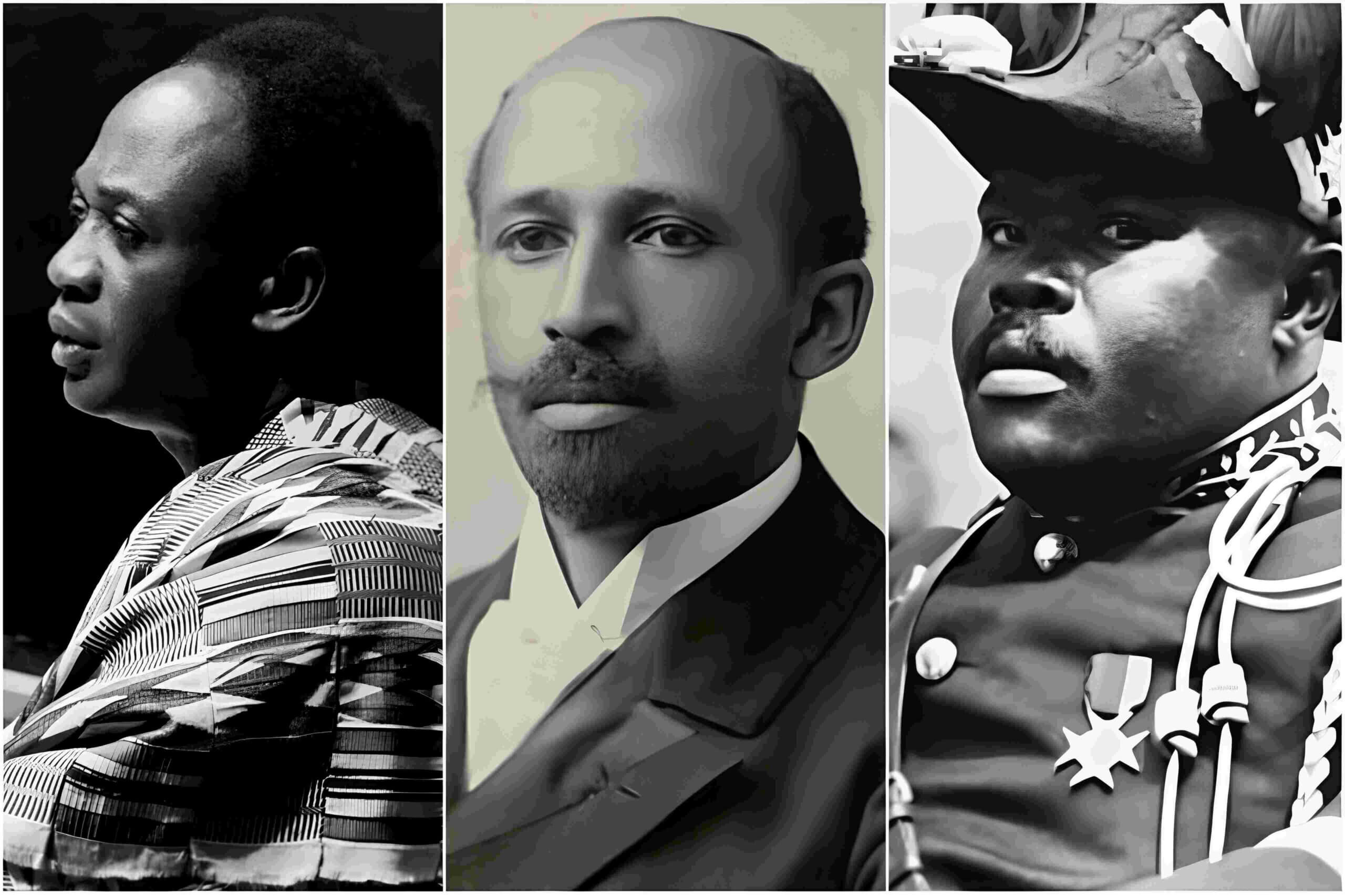
What happens when millions of people scattered across different countries begin to imagine themselves as one people?
That question sits at the heart of Pan-Africanism, one of the most influential political and cultural ideas to emerge from the African experience.
From the streets of Jamaica to the political halls of Ghana, Pan-Africanism developed around a powerful belief: Africans and people of African descent share a common history, common struggles and, potentially, a common future.
But the movement did not begin with one man.
It was built by generations of thinkers, activists, writers and political leaders who challenged colonialism, racism and the political fragmentation of Africa.
Among the most influential were Marcus Garvey and Kwame Nkrumah.
Marcus Garvey: “Africa for Africans”


Born in Jamaica in 1887, Marcus Garvey became one of the most prominent Black nationalist leaders of the early 20th century.
His message was bold.
Black people should develop economic power, political confidence and institutions capable of advancing their own interests.
Through the Universal Negro Improvement Association (UNIA), Garvey built an international movement connecting Black communities across Africa, the Caribbean, the United States and elsewhere.
His famous vision of “Africa for the Africans” was not simply a geographical slogan.
It represented a demand for dignity, self-determination and control over African affairs.
Garvey also promoted the Black Star Line, a shipping venture intended to strengthen economic connections between people of African descent and Africa.
Although the project eventually collapsed amid financial and legal difficulties, the broader idea survived.
Garvey had helped convince millions that African identity could be transformed from something colonialism attempted to suppress into a source of political strength.
From Identity to Political Liberation
Pan-Africanism continued evolving after Garvey.
African intellectuals and activists increasingly connected racial equality with the struggle against European colonial rule.
The Pan-African Congresses, particularly those associated with figures such as W.E.B. Du Bois, created international platforms where African and diasporic leaders could debate the future of the continent.
The conversation was changing.
It was no longer only about how Black people should respond to racism.
It was becoming a question of who should govern Africa.
And then came Ghana.
Kwame Nkrumah Takes the Idea Further


When Kwame Nkrumah led Ghana to independence in 1957, something extraordinary happened.
For the first time in sub-Saharan Africa, a British colony became an independent state under African leadership.
Nkrumah understood that Ghana’s independence could not be treated as an isolated national victory.
He famously warned:
“The independence of Ghana is meaningless unless it is linked up with the total liberation of Africa.”
That sentence captured the next phase of Pan-Africanism.
For Nkrumah, political independence was only the beginning.
Africa also needed economic independence, continental cooperation and freedom from systems that allowed foreign powers to continue controlling African resources and economies.
Nkrumah Wanted More Than Independent Flags
Nkrumah supported the idea of a politically united Africa.
His vision went beyond countries simply becoming independent one by one.
He imagined African states working together through common institutions and eventually moving toward a form of continental government.
The idea was controversial.
Some African leaders believed newly independent nations first needed to consolidate their sovereignty and develop independently.
Others feared that rapid political union could create another form of centralized power.
The disagreement exposed one of Pan-Africanism’s biggest challenges:
Should Africa unite politically first, or should individual nations build themselves before pursuing deeper continental integration?
The debate has never completely disappeared.
From the OAU to the African Union
The Pan-African dream eventually influenced the creation of the Organisation of African Unity (OAU) in 1963.
The OAU brought independent African states together around principles including sovereignty, territorial integrity and opposition to colonialism and apartheid.
Decades later, the African Union (AU) replaced the OAU in 2002.
The AU expanded the continental project, focusing on political cooperation, peace and security, economic integration and development.
It is not the fully united Africa Nkrumah imagined.
But the institution represents one of the clearest descendants of the Pan-African idea.
Why Pan-Africanism Still Matters
Pan-Africanism is sometimes reduced to speeches about African unity.
Its history is much deeper.
It raises difficult questions about African sovereignty, economic independence, cultural identity, colonial borders and control of natural resources.
Africa is home to more than 50 countries, hundreds of ethnic communities and thousands of languages.
Those differences are real.
But Pan-Africanism argues that diversity does not have to prevent cooperation.
In fact, Africa’s size and resources make cooperation even more important.
The continent possesses enormous mineral wealth, agricultural potential, youthful populations and growing consumer markets.
Yet many African economies still depend heavily on exporting raw materials while importing finished products.
That is precisely the kind of economic relationship Pan-African thinkers warned could preserve dependency even after political independence.
The Legacy of Garvey and Nkrumah
Garvey gave Pan-Africanism a powerful language of Black pride, self-determination and global African identity.
Nkrumah transformed that vision into a political programme connected to African independence and continental unity.
Their approaches were different.
Their historical circumstances were different.
But they shared a central conviction:
Africans should have the power to determine Africa’s future.
That idea continues to influence African politics, culture, business, education and the African diaspora.
Pan-Africanism therefore is not simply a chapter in African history.
It is an unfinished conversation.
And perhaps its biggest question remains the same one that confronted Nkrumah decades ago:
Can a continent divided into many nations build enough unity to control its own destiny?
